Work Record¶
Author: Gary Samuelson
Date: May 16, 2026
Status: Updated — May 17, 2026
Technology forgets business — again. It chooses itself. No value chain means no anchor, and without an anchor, capability optimizes toward capability. AI didn't correct that — it handed IT the fastest engine in history with the same blind spot. The flywheel spins faster — the business barely moves. The drivetrain — domains, functional value chains, the workflows that produce real outcomes — still hangs disconnected. Somewhere in the driveway, the minivan waits — the business, ready to conquer, needing only to move. The neighbors hear the engine roar in the driveway while the kids are running late to soccer practice — someone still needs to stop at the grocery store on the way home.
AI didn't change what IT has always done. It just made the flywheel spin faster.
The flywheel spins. The work record sits untouched. That's the gap.
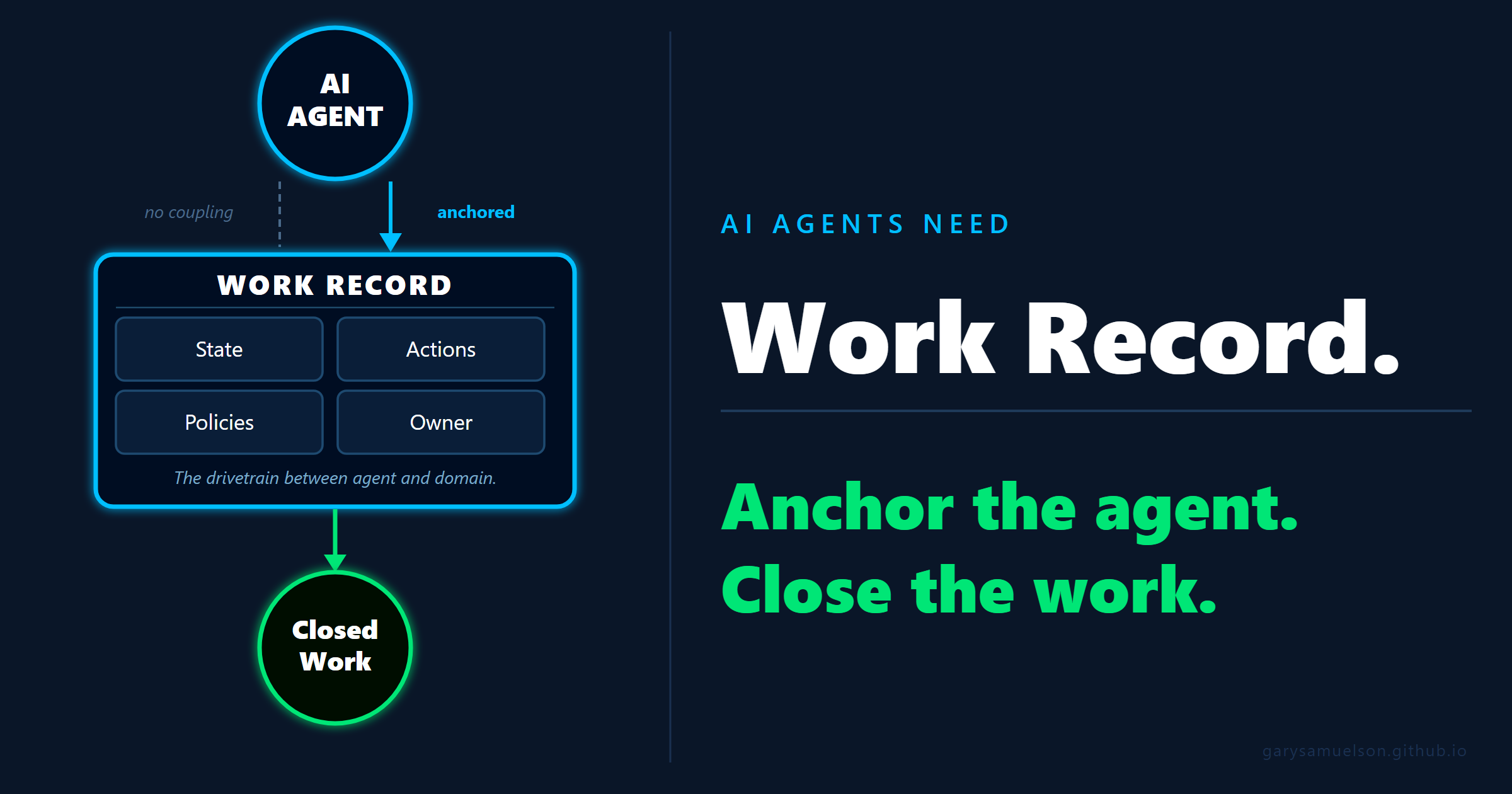
Every enterprise workflow already produces a discrete, trackable unit of work — a ticket, an invoice, a loan application, a case. That object carries state, allowed actions, constraints, and a named owner. An agent anchored to it closes work. An agent floating above it produces output nobody owns. Nate B. Jones named this directly.
The Work Record is the drivetrain — the coupling between AI capability and the business domain. It is the formal representation of one discrete unit of business activity: this ticket, this invoice, this loan application, this case. It carries current state, the valid next moves, the policies that apply at this stage, and the named owner accountable for advancing it. Connect an agent to that record and it connects to the value chain — to the functional purpose, to the reason the business does what it does. The engine finds the wheels. Without it, the engine roars. The minivan waits in the driveway.
Jones calls this the trillion-dollar opportunity: the value sitting in enterprise workflows that agents could capture — if they were properly anchored.
Properly anchored means the agent knows what unit of work it is acting on.
Not just a prompt. A discrete, trackable piece of work that moves through your organization and eventually delivers something of value — or fails to. Think about a lemonade stand. Lemons are bought, squeezed, mixed, poured — a lot of activity. But the value lands in a specific moment: the customer takes the cup on a hot afternoon and hands over 50 cents. That exchange is the unit of work closing. The customer got what they paid for. The stand owner earned the revenue. Everything before it was process. That moment is the value.
Enterprise work is the same. A support ticket closes when the customer's problem is solved and the SLA is met. An invoice posts when cash moves. A loan application ends when a borrower walks out funded — or doesn't. An employee is onboarded and becomes productive. These are the moments your organization experiences value: revenue recognized, a customer retained, a risk mitigated, a regulation satisfied. Value is received at the unit of work — nowhere else in the chain.
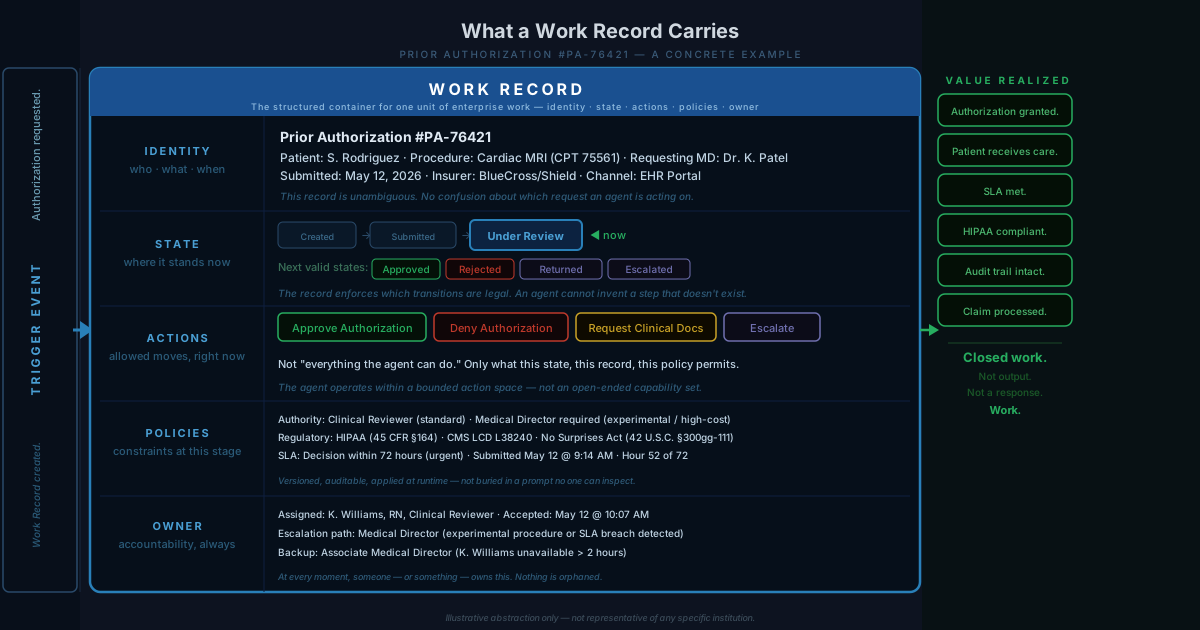
The Work Record is the structured container for one of those moments. It carries the identity of this specific unit of work — this ticket, this invoice, this application. It tracks current state and the full history of transitions. It specifies what actions are valid right now. It enforces the policies that apply at this stage. And it names the owner — the person, role, or agent accountable for advancing it to completion [7, 8].
Why This Matters: Sit Closer to the Business Object¶
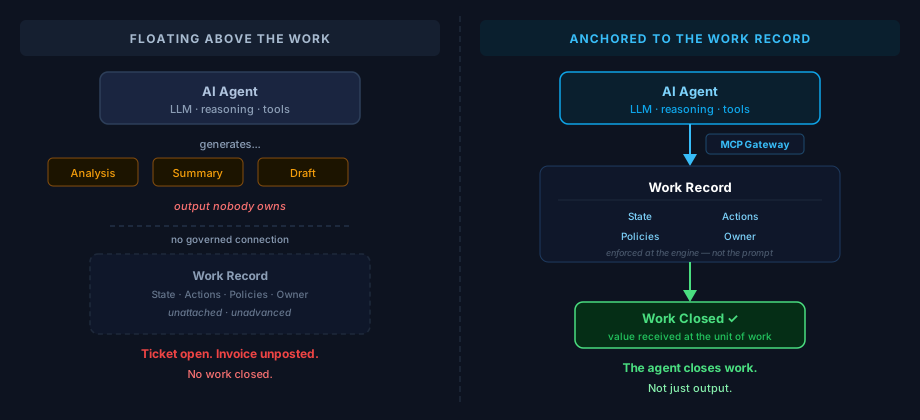
Jones' thesis reduces to a single practitioner-level instruction: sit closer to the business object. Generic AI capability — the LLM, the reasoning loop, the agent framework — becomes valuable only at the moment it attaches to a specific business object and the actions defined on it. Reasoning power in the abstract does not close work. Proximity to the Work Record does. The failure mode is the inverse: agents that float above the work object, producing analysis, drafts, summaries, and recommendations without ever being bound to a record that has a state, a set of allowed moves, and a named owner. They feel powerful. They produce nothing closed. A support ticket gets a beautifully written response and stays open. An invoice gets analyzed and never posts.
The infrastructure that lets an AI-enabled agent sit on the work object — not above it — already exists, in production, today. BPM gives us the practice and methodology. BPMN gives us the modeling language. A BPM runtime (Camunda 8) gives us the live process instance — the Work Record — with its state machine, its task palette, its policy enforcement, and its owner assignments [7, 8]. The piece that completes the loop is the adapter that lets an AI-enabled agent see and act on that record through the same governed interface a human would: the Model Context Protocol (MCP). Camunda 8.9's MCP Gateway is exactly that adapter, and it shipped. The path from Jones' thesis to a deployed agent that closes work — not just generates output — is no longer a research project. It is configuration work on a runtime that thousands of organizations are already operating. For the full pattern — agent as worker, task schema, measured output — see the companion piece The Working AI: Put to Task with Measured Output.
Anchored to that record, the agent also knows what it is allowed to do next — not everything it is capable of, but the specific moves that are valid given where this work object stands right now. It operates within constraints that reflect the real world — approval thresholds, regulatory requirements, escalation rules — not rules embedded in a prompt that nobody can audit or version. And there is a clear owner at every moment — a role, a person, or another agent who holds accountability and knows what to do when something can't be resolved.
Without all of that, an agent can generate output indefinitely. The trouble is that output isn't the same as work. A support ticket answered but not closed, an invoice processed but not posted, a loan application reviewed but not advanced — these are outputs. They are not closed work. The difference between the two is exactly what Jones is pointing at, and it is exactly what a properly structured Work Record enforces.
Testing Jones' Thesis: What Leading AI Platforms Actually Do¶
Jones' claim is precise: AI agents fail to deliver enterprise value not because the models are weak, but because agents are floating above the work — unbound from the structured, stateful, policy-governed work objects that enterprise workflows require.
That is a falsifiable claim. We can check it against the platforms teams are actually deploying today.
A survey of the leading AI agent frameworks reveals a consistent structural finding: every one of them solves the agent coordination problem. None of them solves the work object problem.
LangGraph coordinates agents as nodes in a directed graph, passing a
developer-defined State dictionary between nodes. Checkpointing persists state
across interruptions. The state dict contains whatever the developer puts in it —
no inherent business-domain object, no typed lifecycle, no policy enforcement. What
carries between agents is data. What does not carry is domain governance.
AutoGen (Microsoft) organizes agents into teams coordinated through shared
conversation history. The most sophisticated pattern — SelectorGroupChat — uses
an LLM to select the next speaker based on the accumulated chat transcript. Work is
considered complete when an agent produces the text "TERMINATE" — or the message
count hits a configured limit. No process instance. No state machine. No owned record.
OpenAI Agents SDK routes work through handoffs — a triage agent delegates to specialist agents that execute tools. State is the context window. Tracing is added as observability tooling after the fact. No persistent work object carries between interactions.
Amazon Bedrock Agents uses an orchestrator that breaks tasks into subtasks and calls action groups in sequence. Multi-agent patterns follow a supervisor model — one agent delegates to another as a sub-agent. State is per-session; the trace log is the audit record. No formal state machine at the business domain level.
Temporal is the most architecturally rigorous of the group. Its Workflow
Execution is a durable, long-running unit of work, replayed from an Event
History log for fault tolerance. Explicit state machines are coded directly in
workflow code. Temporal can run for months and provides a full event record. It
solves the durable execution problem exactly — and solves it well. But it has no
business-domain modeling layer. No BPMN. Policy enforcement lives in workflow code.
Owner tracking is not a first-class concept.
Microsoft Semantic Kernel Process Framework is the most revealing case.
Microsoft's team independently introduced Process, Step, and event-driven
transitions — and drew their examples from BPM-canonical scenarios: account
opening, food delivery, support ticket resolution. The vocabulary is BPM
vocabulary. The structure is BPM structure. The framework is marked experimental
as of 2024. What is notable is not just what it gets right — it is that Microsoft's
own AI team, working independently, arrived at a BPM-shaped solution to the same
problem Jones describes. They did not cite BPM literature. They reinvented it.
What None of Them Have¶
Across all six frameworks, the same four capabilities are absent:
- A business-domain work object — a typed record representing the actual unit of enterprise work (loan application #48291, invoice #PO-9912), not a developer-defined state dictionary
- A lifecycle state machine in business terms — not code states, but Application Under Review → Conditions Issued → Approved, with transitions that carry business meaning and regulatory significance
- Policy enforcement at the architecture level — approval thresholds, compliance constraints, and escalation rules enforced by the state machine, not embedded in prompts and not auditable
- Formal owner tracking — who holds accountability now, who it transfers to, with timestamped handoff records that satisfy examination requirements
These frameworks coordinate agents effectively — for information tasks, for question-answering, for document processing and retrieval. For enterprise work — the kind of work Jones is describing, the kind that produces the trillion dollars — you need all four.
Jones is right. The gap he describes is real, structurally consistent across every major AI platform, and it is not a roadmap item. It is a design choice these frameworks have not made, because they are solving a different problem: agent coordination, not governed work closure.
BPM + Camunda 8 + MCP Gateway is what fills that gap — today, in production.
The Piece That Just Changed Everything¶
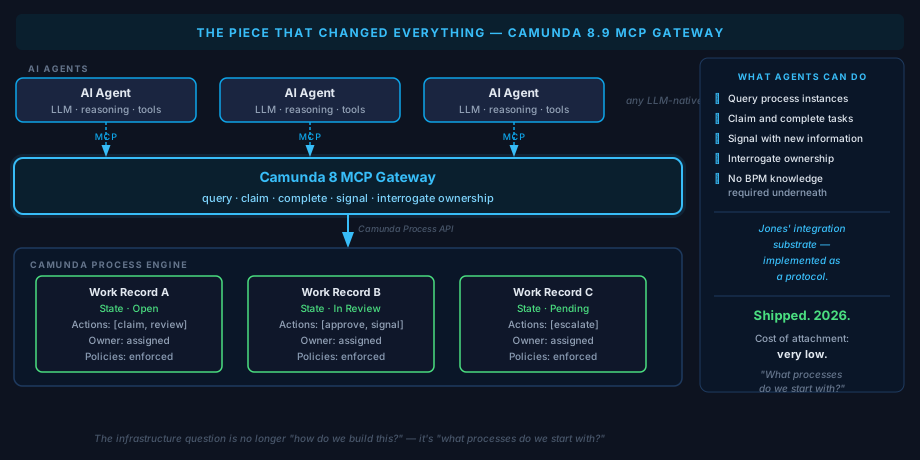
There's one development in 2026 that makes all of this more immediately actionable than it's ever been: the MCP Gateway in Camunda 8.9.
The Model Context Protocol is the emerging standard for how AI agents interact with tools. It's the layer that lets an agent say "I need to check the state of a work object, claim a task, and return a result" — in a protocol that the agent already knows how to use.
Camunda's MCP Gateway exposes the full process engine API surface to AI agents as a structured tool set. An agent with access to the MCP Gateway can query process instances, claim and complete tasks, signal the process with new information, and interrogate the ownership model — all without knowing anything about the BPM architecture underneath.
This is Jones' integration substrate — the coherent data layer that agents can walk across the top of — implemented as a protocol. And it shipped this year.
The cost of attaching an AI agent to a BPM-managed work record is now very low. The infrastructure question isn't "how do we build this?" It's "what processes do we start with?"
Where BPM Is Going From Here¶
BPM hasn't been sitting on the shelf waiting for AI to show up. It's here, it's active, and it's already engaging AI technology — in exactly the direction Jones' framework points.
Agentic BPM is the active research frontier. The 2023 Agentic BPM Manifesto (Dumas et al.) laid out the research agenda for AI-augmented process management systems — governance, transparency, auditability, and the formal treatment of autonomous agents as first-class workers in a process. That research agenda is now producing tooling.
Object-Centric Process Mining (OCEL 2.0) is the measurement foundation Jones' framework needs but doesn't yet have. When van der Aalst's team formalized the OCEL 2.0 standard, they defined a data structure that is, essentially, Jones' Work Record — object ID, type, attributes, event sequence, and object relationships — expressed as a format that process mining tools can analyze at scale. Organizations adopting OCEL 2.0 can answer, empirically, whether their agents are closing work — not by anecdote, but by conformance analysis against the actual event log.
Semantic process annotation (the work of Rebmann, van der Aa, and others) is the research program that connects process events to formal domain ontologies — making it possible for agents to reason about the meaning of what's in the work record, not just the data. This is what transforms BPM from a coordination infrastructure into a reasoning substrate.
Each of these is an active, funded, publishing research area. The field is in motion.
The Foundation Already Exists¶
Jones named the opportunity clearly, and the market response has been strong because he's right: the trillion dollars in agentic workflow value depends on infrastructure that most AI deployments skip.
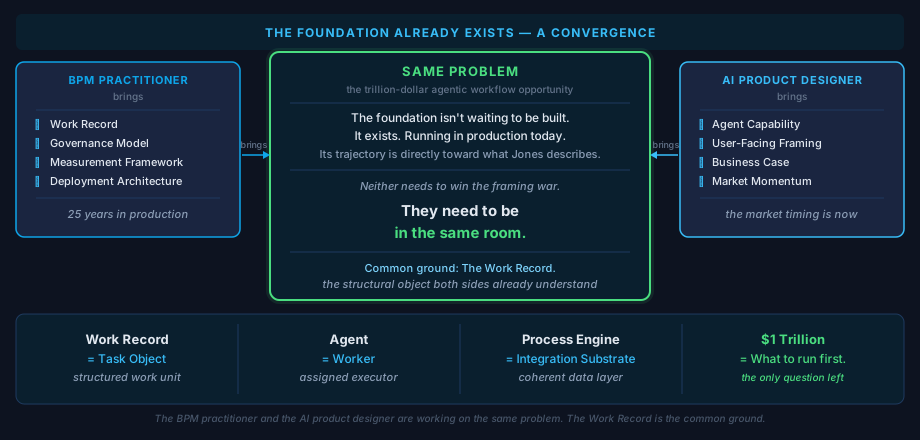
What I'd add — as someone who has spent years at the intersection of BPM, semantic AI, and process intelligence — is that the infrastructure isn't waiting to be built. It exists, it's running in production organizations today, and its trajectory is directly toward the capability Jones is describing.
The BPM practitioner and the AI product designer are now working on the same problem. The BPM practitioner is bringing the work record, the governance model, the measurement framework, and the deployment architecture. The AI product designer is bringing the agent capability, the user-facing framing, and the business case.
Neither of them needs to win the framing war. They need to be in the same room.
The work record is the task object. The agent is the worker. The process engine is the integration substrate. The trillion dollars is in figuring out what to run first.
Appendix: What Is a Work Record? The BPM Definition¶
The term "Work Record" comes from Nate B. Jones' 2026 framing, but the concept has formal antecedents in BPM theory that are worth naming precisely — because the precision matters when you're building production systems.
The Academic Definition¶
In BPM literature, the Work Record corresponds to what practitioners call a process instance — or, in case management theory, a case. Weske's standard reference text defines a process instance as "the execution of a process for a specific set of input data": a discrete, named occurrence of a process, carrying its own data state, lifecycle, and audit trail, distinct from every other occurrence of the same process [1].
Dumas et al., in the leading graduate-level BPM text, define the analogous concept as a case: a specific occurrence of a business process characterized by its case ID, its current state, the data it carries, and the events that have affected it. The case is the unit of work management. Everything else — tasks, gateways, policies, assignments — operates in service of advancing the case to a defined completion state [2].
The BPMN 2.0 specification (OMG, 2013) formalizes this as a process instance with a defined lifecycle: instantiation, active execution, suspension, and termination (complete or error). Each instance carries typed process variables — the data bundle representing the real-world work object — and a full execution history maintained by the BPM engine at runtime [3].
Ruecker, in the practitioner-facing counterpart to these academic texts, describes the workflow engine's foundational capability as maintaining "all running process instances, including their current state and historical audit data" [7]. The vocabulary is different from Jones; the structure is identical. Every process instance in a running BPM engine is a Work Record — uniquely identified, stateful, action-constrained, policy-bearing, and owned. Ruecker's more recent treatment with Strauch (2025) extends this into the AI-augmented orchestration layer, where agents operate as task executors within the same process instance structure [8].
The Data Structure Underneath¶
In object-centric process mining, van der Aalst's team formalized the Work Record concept as the OCEL 2.0 standard (2023). An OCEL object carries: an object ID (the unique identifier of the real-world entity), an object type (the category of work object), typed object attributes (the data bundle), an ordered event sequence (the full timestamped history), and object relationships (connections to other entities involved in the same process) [4].
This is precisely what Jones means by Work Record. The concept is not new. The formal specification of it at a precision level that process mining engines can analyze at scale is what OCEL 2.0 delivered.
Key Citations¶
[1] Weske, M. (2019). Business Process Management: Concepts, Languages, Architectures (3rd ed.). Springer. §4.2 — Process instance lifecycle and data model.
[2] Dumas, M., La Rosa, M., Mendling, J., & Reijers, H. A. (2023). Fundamentals of Business Process Management (3rd ed.). Springer. §1.2 — Case and process instance definitions; §6.3 — Case management and adaptive processes.
[3] Object Management Group. (2013). Business Process Model and Notation (BPMN) Version 2.0.2. OMG Standard. https://www.omg.org/spec/BPMN/2.0.2/ — §10.1: Process instance lifecycle; §8.2: Process variables and data objects.
[4] Berti, A., Park, G., Rafiei, M., & van der Aalst, W. M. P. (2023). OCEL 2.0 Specification. RWTH Aachen / Process and Data Science Group. https://www.ocel-standard.org/ — Object-centric event log format, object attributes, and inter-object relationships.
[5] Dumas, M., Fournier, F., Limonad, L., Marrella, A., Montali, M., Pfeiffer, P., & Di Francescomarino, C. (2023). Agentic BPM Manifesto: AI-Augmented Process Management Systems. Position paper, BPM 2023. — Research agenda for autonomous agent integration in process management systems.
[6] Jones, N. B. (2026, May). The Trillion Dollar Agentic Workflow Opportunity. LinkedIn. — Defines Work Record, Actions, Policies, and Owners as the four infrastructure primitives for enterprise agentic AI value realization.
[7] Ruecker, B. (2021). Practical Process Automation: Orchestrate Microservices, Serverless Functions, and More. O'Reilly Media. Chapter 2, "Workflow Engines and Process Solutions" — Core Capabilities: Durable State (Persistence). https://www.oreilly.com/library/view/practical-process-automation/9781492061441/ch02.html
[8] Ruecker, B., & Strauch, L. (2025). Enterprise Process Orchestration. Wiley. Introduction — Process Orchestration in the Context of Automation. https://learning.oreilly.com/library/view/enterprise-process-orchestration/9781394309672/
This article is a companion to The Working AI: Put to Task with Measured Output, which develops the agent-as-worker and AI-Inside patterns in full detail.
References for the academic version of this piece — including arXiv preprints for OCEL 2.0, semantic process annotation, and the Agentic BPM Manifesto — will be available in the ResearchGate preprint.
© 2026 Gary Samuelson | CC BY-NC-ND 4.0 — Share freely with attribution. No commercial use. No derivatives without permission.